
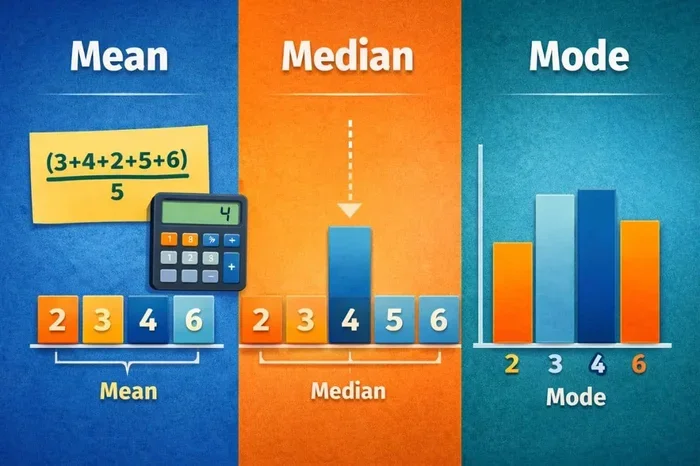
The median meaning is simple: it is the middle value in a sorted list of numbers. Understanding the median helps you make better sense of data, especially when averages are misleading. This guide covers what the median is, how to find it, and why it really matters in real life.
Have you ever heard someone talk about the median meaning and felt completely lost? You are not alone. Many people hear the word “median” and think it is just another fancy math term. But the truth is, the median is one of the most useful numbers you will ever encounter. It shows up in news reports, paychecks, real estate listings, and health studies.
In this article, we will break down the median meaning in plain language. You will learn what it is, how to calculate it, and why it often tells a better story than the average. By the end, you will see data in a whole new way. Let us dive in.
Key Takeaways
- The median meaning: it is the middle number in a sorted data set that splits values into two equal halves.
- Median vs. mean: the median is less affected by extreme values, making it a more reliable measure of center.
- How to find it: sort your data, count the values, and pick the middle one (or average the two middle ones).
- Real-world uses: median income, median house prices, and median age are all common applications.
- Common mistakes: forgetting to sort data or confusing the median with the arithmetic mean are top errors.
- Why it matters: the median gives a truer picture of typical values when data is skewed or has outliers.
📑 Table of Contents
- What Is the Median Meaning in Simple Terms
- How to Find the Median: A Step-by-Step Guide
- Why the Median Matters More Than You Think
- Median Meaning in Real Life
- Median Formula and How to Use It
- Common Mistakes People Make with the Median
- Median vs Mean vs Mode: A Quick Comparison
- The Median in Statistics and Data Analysis
- Why the Median Really Matters
- Conclusion
What Is the Median Meaning in Simple Terms
The median meaning is straightforward. It is the middle value in a list of numbers that has been sorted from smallest to largest. When you line up all your data points, the median sits right in the center. Half the values are above it, and half are below it.
Think of it like this. You and nine friends line up by height. The person standing in the exact middle is the median. Five people are taller, and five are shorter. That is the core idea behind the median meaning.
The Basic Idea Behind the Median
The median belongs to a group of numbers called measures of central tendency. These are values that describe the center of a data set. The three main measures are the mean, the mode, and the median. Each one tells you something different about your numbers.
The mean is what most people call the average. You add all the numbers and divide by how many there are. The mode is the number that appears most often. And the median is the middle value. Together, these three give you a fuller picture of your data.
What makes the median special is its simplicity and resilience. It does not care about extremely high or low numbers. It just looks for the center. This makes the median meaning incredibly valuable in real-world situations.
How the Median Differs from the Average
Many people use the words “median” and “average” interchangeably. That is a mistake. The average usually refers to the arithmetic mean. The median is a different statistical measure entirely.
Here is a quick example. Say five people earn these amounts per year: $30,000, $35,000, $40,000, $45,000, and $1,000,000. The mean or average is $230,000. But the median is $40,000. That huge $1 million salary pulls the average way up. The median stays grounded in what most people actually earn.
This is why understanding the median meaning is so important. It gives you a more honest view of what is typical. The average can be distorted by just one extreme value.
How to Find the Median: A Step-by-Step Guide
Finding the median is easier than you might think. You do not need a calculator or advanced math skills. Just follow a few simple steps, and you will have your answer.
Finding the Median with an Odd Number of Values
When your data set has an odd number of values, the process is very direct.
- Sort your numbers from smallest to largest.
- Count the total number of values.
- Find the middle position using the formula (n + 1) / 2, where n is the total count.
- The value at that position is your median.
Let us try an example. Say your data set is: 3, 7, 1, 9, 5. First, sort it: 1, 3, 5, 7, 9. There are 5 values. The middle position is (5 + 1) / 2 = 3. The third value is 5. So the median is 5. Easy, right?
This is the simplest way to understand the median meaning. You just find the center of the line.
Finding the Median with an Even Number of Values
Things get slightly tricky when you have an even number of values. In this case, there is no single middle number. Instead, you have two numbers in the center.
- Sort your data from smallest to largest.
- Identify the two middle values.
- Add them together and divide by 2.
Here is an example. Say your numbers are: 2, 4, 6, 8, 10, 12. There are 6 values. The two middle ones are 6 and 8. Add them: 6 + 8 = 14. Divide by 2: 14 / 2 = 7. So the median is 7.
This method ensures you still get a single central value even when there is no exact middle. The median meaning stays consistent whether you have an odd or even count.
Why the Median Matters More Than You Think
The median is not just a textbook concept. It has real power in everyday decision-making. Once you grasp the median meaning, you will start noticing it everywhere.
The Median and Outliers
An outlier is a value that is very different from the rest of the data. Outliers can completely change the arithmetic mean. But the median barely notices them.
Imagine a neighborhood where most homes are worth $250,000. But one mansion sells for $5 million. The mean house price jumps to $650,000. That does not reflect what most homes are worth. The median house price stays at $250,000. That is a much better representation of the typical home.
This is why real estate reports, government surveys, and news outlets love using the median. It cuts through the noise of extreme values and shows the true picture.
When the Average Lies
The average can be misleading. This happens when a data set is skewed, meaning the values are not evenly spread out. In a skewed distribution, a few very high or very low values pull the mean away from the center.
The median does not get pulled in any direction. It stays put in the middle. This makes the median meaning far more trustworthy when your data is not symmetrical.
Think about test scores in a class. If most students score around 75, but one student scores 100, the average might be 78. The median is likely still close to 75. The median tells you what a typical student achieved, not what the one star student achieved.
Median Meaning in Real Life
The median shows up in many areas of daily life. Understanding where and why it is used helps you become a smarter consumer of information.
Median Income and Wealth
When you hear about median income on the news, they are talking about the middle value in a list of all incomes. Half of people earn more, and half earn less.
Governments and economists prefer the median over the mean for income data. Why? Because a small number of billionaires can make the average income look very high. The median gives a much more realistic picture of what a typical person earns.
Next time you see a headline about income, check if it says “median.” It is a much more honest number.
Median House Prices
Real estate listings often report the median house price for a city or neighborhood. This is the price where half the homes sold for more and half sold for less.
The median is preferred here because luxury homes can skew the average price upward. If a few $2 million homes sell in an area where most homes are $300,000, the average price jumps. But the median stays at $300,000. That tells buyers and sellers what the market really looks like.
Median Age in Populations
The median age of a country tells you the age at which half the population is younger and half is older. It is a useful way to understand a country’s demographic makeup.
A country with a median age of 25 has a young population. A country with a median age of 45 has an older population. The median gives a quick snapshot without getting lost in extreme ages at either end.
Median Formula and How to Use It
You do not need a complex median formula to find the middle value. But knowing the basic approach helps you apply it correctly every time.
The Simple Median Formula
For a data set with n values, the position of the median is:
Position = (n + 1) / 2
If n is odd, the value at that position is the median. If n is even, you average the two values at positions n/2 and (n/2) + 1.
This simple formula works for any size data set. Whether you have 5 numbers or 5,000, the logic stays the same.
Finding the Median in Grouped Data
Sometimes your data is grouped into ranges, like income brackets or age groups. In these cases, you use a slightly different approach called the median formula for grouped data.
You find the median class, which is the group that contains the middle value. Then you use a formula that estimates the exact median within that class. This method is common in statistics and research papers.
For most everyday purposes, the simple method works perfectly. The grouped data approach is more for advanced analysis and research.
Quick Tips for Using the Median
- Always sort your data first. The median only works on ordered lists.
- Watch for repeated values. They do not change the process, but they are part of your count.
- Use the median when data has extreme values. It gives a more reliable center than the mean.
- Remember the median works with ordinal data. This means data that can be ranked, even if the differences between values are not equal.
- Practice with real numbers. Try finding the median of your monthly expenses or weekly steps. It makes the concept stick.
Common Mistakes People Make with the Median
Even people who understand the median meaning can make errors. Here are the most common ones to avoid.
Confusing Median with Mean
This is the number one mistake. The median is the middle value. The mean is the average. They are not the same thing. Always check which one a report or article is using.
When someone says the “average salary” is $100,000, ask yourself if they mean the mean or the median. The difference could be thousands of dollars.
Forgetting to Sort the Data
The median requires a sorted list. If you skip this step, your answer will be wrong every time. Always arrange your numbers from smallest to largest before finding the middle value.
This is a simple step, but it is easy to overlook when you are working quickly or with a large data set.
Ignoring the Difference Between Odd and Even Counts
As we covered earlier, odd and even data sets require slightly different approaches. For odd counts, you pick the single middle value. For even counts, you average the two middle values. Mixing these up will give you an incorrect median.
Median vs Mean vs Mode: A Quick Comparison
Understanding how the median fits with other measures of center helps you choose the right one for any situation.
- Mean (Average): Add all values and divide by the count. Sensitive to outliers.
- Median: The middle value in a sorted list. Resistant to outliers.
- Mode: The most frequent value. Useful for categorical data.
Each measure has its place. But when you want a reliable center for numerical data, the median is often the best choice.
The Median in Statistics and Data Analysis
The median plays a huge role in statistics and data analysis. Researchers use it to describe the center of a frequency distribution. It is especially valuable when working with data that is not normally distributed.
In a normal distribution, the mean, median, and mode are all the same. But in real life, data is rarely perfectly normal. Income data, home prices, and survival times are often skewed. In these cases, the median is the go-to measure.
Many statistical tests are designed specifically for the median. These non-parametric tests do not assume a normal distribution. They are powerful tools when your data does not meet the requirements for tests based on the mean.
Why the Median Really Matters
We have covered a lot of ground. So let us bring it all together. Why does the median meaning matter so much?
First, it gives you a clear picture of what is typical. When extreme values distort the average, the median stays honest. Second, it is easy to calculate and understand. You do not need a degree in statistics to find it. Third, it applies to so many areas of life, from personal finance to public health to business decisions.
The next time you see a news report about income, prices, or ages, look for the median. It will give you a more accurate and trustworthy picture than the average alone.
Understanding the median meaning is a small skill that makes a big difference. It helps you think more critically about the numbers you encounter every day. And in a world full of data, that kind of critical thinking is invaluable.
So the next time someone mentions the median, you will know exactly what they mean. You will understand why it matters. And you will be able to use it to make smarter decisions. That is the real power of knowing the median.
Conclusion
The median meaning is the middle value in a sorted data set. It is a simple but powerful statistical measure that tells you what is typical without being swayed by extreme values. Whether you are looking at median income, median house prices, or just your own monthly spending, the median gives you a clearer, more honest picture than the average alone.
Now that you know how to find the median and why it matters, you can apply this knowledge in real life. Sort your data, find the middle, and use it to make better decisions. The median is one of the most practical tools in math, and now you know how to use it.
Keep this concept in your back pocket. The next time you see a headline about averages, ask yourself: “Is this the mean or the median?” That one question can change how you see the world.
Frequently Asked Questions
What is the median meaning in math?
The median meaning in math is the middle value in a sorted list of numbers. When you arrange your data from smallest to largest, the median is the number that falls right in the center. Half the values are above it, and half are below it.
How is the median different from the average?
The average, or arithmetic mean, is calculated by adding all values and dividing by the count. The median is simply the middle value. The key difference is that the median is not affected by extreme values or outliers, while the mean can be pulled in any direction by them.
When should I use the median instead of the mean?
Use the median when your data set has outliers or is skewed. This is common with income data, home prices, and survival times. The median gives a more accurate picture of what is typical when extreme values are present.
Can the median be a number that is not in the data set?
Yes, it can. When you have an even number of values, you average the two middle numbers. The result may not be an actual value in your data set. For example, if your two middle values are 6 and 8, the median is 7, which was not in the original list.
What is the median formula for finding the middle position?
The basic formula is (n + 1) / 2, where n is the total number of values. This gives you the position of the median in a sorted list. For odd counts, the value at that position is the median. For even counts, you average the two values at the center positions.
Why do news reports use the median instead of the average?
News reports use the median because it gives a more realistic picture of typical values. Income, home prices, and wealth data often have extreme values that skew the average. The median cuts through that distortion and shows what most people actually experience.