
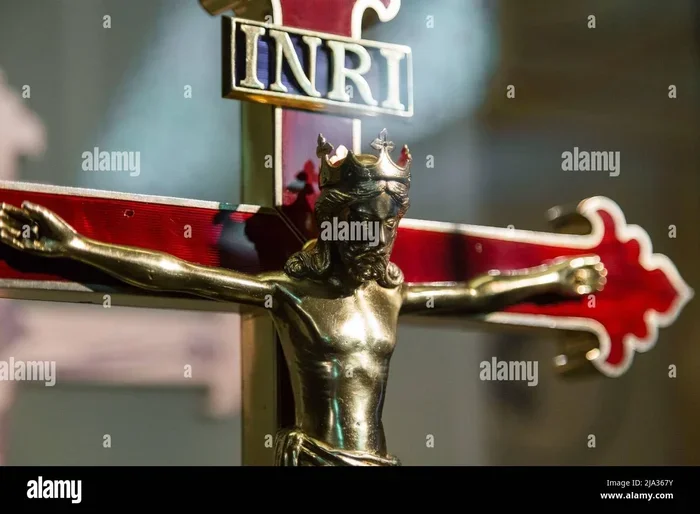
The INRI meaning refers to the Latin inscription placed above Jesus Christ during the crucifixion. It stands for “Iesus Nazarenus Rex Iudaeorum,” translating to “Jesus of Nazareth, King of the Jews.” This powerful phrase carries deep historical, biblical, and spiritual significance that continues to resonate across Christianity today. Understanding the INRI meaning opens a window into ancient Roman practices, sacred scripture, and the heart of Christian faith.
Have you ever looked at a cross or a religious painting and noticed the letters INRI carved or displayed above it? Maybe you saw it in a church, on a piece of jewelry, or in a movie about the Bible. Those four letters carry one of the most powerful messages in Christian history. The INRI meaning is more than just a set of initials. It tells a story of sacrifice, royalty, and fulfillment of prophecy.
In this article, we will explore the INRI meaning in full detail. You will learn where the phrase comes from, what it means in Latin, why it was written on the cross, and how it shaped Christian art and belief. Whether you are a curious reader, a student of the Bible, or someone who wants to understand religious symbols better, this guide has you covered.
Key Takeaways
- INRI stands for a Latin phrase: It translates to “Jesus of Nazareth, King of the Jews” and was placed on the cross during the crucifixion.
- The inscription has deep historical roots: It reflects Roman customs of labeling criminals and carries a powerful political message.
- INRI appears in all four Gospels: Each Gospel references the titulus, reinforcing its importance in biblical history.
- The letters hold symbolic meaning in Christian art: Artists have used INRI in paintings, sculptures, and stained glass for centuries.
- Misconceptions exist about the acronym: Some alternative interpretations exist, but the Latin meaning is the most widely accepted.
- The INRI meaning still matters today: It connects believers to the Passion of Christ and the core message of Christianity.
📑 Table of Contents
- What Does INRI Stand For?
- The Historical Origin of the INRI Inscription
- The Biblical Account of the INRI Plaque
- INRI Meaning in Christian Art and Symbolism
- Why the INRI Meaning Still Matters Today
- Common Misconceptions About INRI
- Quick Tips for Understanding INRI in Context
- Expert Insights on the INRI Meaning
- Key Takeaways
- Conclusion
What Does INRI Stand For?
The letters INRI stand for a Latin phrase that was written during the crucifixion of Jesus Christ. The full phrase is “Iesus Nazarenus Rex Iudaeorum.” Each word carries specific meaning that together forms a powerful declaration. Let us break it down word by word.
Iesus Nazarenus
The first two words identify the person. “Iesus” is the Latin form of “Jesus.” “Nazarenus” means “of Nazareth.” So together, these words point to Jesus from Nazareth. This was important because many people in that region knew Jesus by his hometown rather than by his full name.
Rex Iudaeorum
The last two words declare a title. “Rex” means “King.” “Iudaeorum” means “of the Jews.” So the full title reads “King of the Jews.” This was not a title Jesus claimed for himself in a political sense. It was a statement placed above him by Roman authority during his crucifixion.
When you put it all together, the INRI meaning reads: “Jesus of Nazareth, King of the Jews.” Simple as that. Four Latin words that changed the course of history.
The Historical Origin of the INRI Inscription
To understand the INRI meaning fully, we need to travel back to first-century Judea. The Roman Empire ruled the region, and crucifixion was a common form of punishment. The Romans used crucifixion not only to execute criminals but also to send a public message. The inscription on the cross was part of that message.
Roman Crucifixion Practices
Roman soldiers often placed a titulus above the victim during crucifixions. A titulus was a wooden board or plaque that displayed the crime the person committed. This served as a warning to others who might consider breaking Roman law. The practice was meant to be public and humiliating.
In the case of Jesus, the charge was sedition. The Roman authorities saw him as a threat because he claimed to be a king. The INRI inscription was their way of mocking him and warning others. But what they intended as humiliation, God used for a greater purpose.
The Role of Pontius Pilate
Pontius Pilate was the Roman governor who ordered the crucifixion of Jesus. According to the New Testament, Pilate wrote the inscription himself. The Gospel of John tells us that Pilate wrote “Jesus of Nazareth, the King of the Jews” in Hebrew, Latin, and Greek. This was significant because it made the message visible to many different people in the region.
Pilate also famously declared, “What I have written, I have written.” This shows that he was aware of the deeper meaning behind the inscription. He may not have fully understood the spiritual significance, but he recognized the power of the words.
The Biblical Account of the INRI Plaque
The INRI meaning is not just a historical curiosity. It is recorded in all four Gospels of the New Testament. Each Gospel provides a slightly different perspective on the inscription, but they all agree on the core message.
Matthew’s Account
In the Gospel of Matthew, the soldiers cast lots for Jesus’s clothing and placed the charge above his head. Matthew writes about the mocking that took place as people passed by and read the inscription. The religious leaders especially challenged the message, saying Jesus should come down from the cross if he truly was the King of Israel.
Mark’s Account
Mark’s Gospel also describes the inscription and the mocking. He emphasizes the irony of the situation. The sign that was meant to mock Jesus actually declared a truth greater than anyone present understood at the time.
Luke’s Account
Luke focuses on the broader scene of the crucifixion. He mentions the inscription and the crowd that gathered. Luke highlights the compassion Jesus showed even in his final moments, including his words to the criminal beside him.
John’s Account
The Gospel of John provides the most detailed description of the INRI inscription. John specifically mentions that the charge was written in Hebrew, Latin, and Greek. He also notes that the chief priests objected to the wording and asked Pilate to change it. Pilate refused, saying, “What I have written, I have written.”
Together, these accounts show that the INRI meaning was not hidden or forgotten. It was a public declaration that was witnessed by many people, including soldiers, religious leaders, and ordinary bystanders.
INRI Meaning in Christian Art and Symbolism
Over the centuries, the INRI inscription became one of the most recognizable symbols in Christian art. Artists, sculptors, and craftspeople have included INRI in their works for nearly two thousand years. The letters serve as a powerful reminder of the crucifixion and its spiritual significance.
INRI in Paintings
Many famous paintings of the crucifixion include the INRI inscription. Artists like Matthias Grünewald, Hieronymus Bosch, and Caravaggio featured the letters prominently in their works. The inscription often appears as a small plaque or banner above the figure of Christ on the cross.
These artistic choices were not just decorative. They served as visual theology. Every time a viewer saw the letters INRI, they were reminded of the sacrifice of Jesus and the claim that he was the King of the Jews.
INRI in Sculpture and Architecture
Churches, cathedrals, and religious monuments often feature the INRI inscription. Carved into wooden crosses, displayed on altars, or embedded in stained glass windows, the letters are a constant presence in sacred spaces. They anchor the viewer’s attention on the central event of Christian faith.
Some crosses are designed with the INRI plaque as a separate, raised element. This adds a three-dimensional quality that makes the inscription even more prominent. Whether in a grand cathedral or a small chapel, INRI carries the same weight and meaning.
INRI in Jewelry and Personal Devotion
Many Christians wear crosses with the INRI inscription as a sign of their faith. Cross necklaces, rings, bracelets, and earrings often feature the four letters. For believers, wearing INRI is a personal declaration of faith and a reminder of the sacrifice made on their behalf.
Some people also use INRI in their prayer practices. The letters serve as a focal point for meditation on the Passion of Christ. By reflecting on the INRI meaning, believers can deepen their understanding of the Easter story and the significance of Good Friday.
Why the INRI Meaning Still Matters Today
You might wonder why a two-thousand-year-old Latin inscription still matters. The answer lies in the enduring power of the message it carries. The INRI meaning is not just about history. It is about faith, identity, and the core message of Christianity.
A Declaration of Truth
The inscription on the cross was meant to be a statement of fact. Even though the Roman authorities wrote it to mock Jesus, it declared a truth that could not be undone. Jesus was indeed the King of the Jews, not in a political sense, but in a spiritual one that changed the world forever.
This idea resonates deeply with Christians today. The INRI meaning reminds believers that truth often looks different from what the world expects. What appeared to be a sign of defeat was actually a sign of victory.
A Connection to Sacred Scripture
The INRI inscription connects directly to Old Testament prophecies about the Messiah. Many believers see the crucifixion and the inscription as the fulfillment of ancient promises. The INRI meaning bridges the gap between the Hebrew scriptures and the New Testament, showing how the story of Jesus was foretold long before he was born.
A Symbol of Hope and Redemption
For millions of Christians around the world, the INRI letters represent hope. The crucifixion was a dark event, but it led to the resurrection. The INRI meaning is a reminder that suffering can lead to redemption, that defeat can turn into victory, and that love is stronger than death.
During Easter celebrations, the INRI inscription takes on special significance. It connects the sorrow of Good Friday with the joy of Easter Sunday. The letters remind believers that the story does not end at the cross.
Common Misconceptions About INRI
There are several misunderstandings about the INRI meaning that are worth clearing up. These misconceptions can lead to confusion, especially for people who are new to studying the Bible or Christian symbols.
Misconception One: INRI Is a Secret Code
Some people think INRI is a hidden or secret code that only a few people understand. In reality, the INRI meaning is straightforward. It is simply a Latin phrase that was written in public for everyone to see. There is no hidden meaning beyond the words themselves.
Misconception Two: INRI Means “Jesus Is Our Redeemer”
You may have heard alternative interpretations of INRI, such as “Jesus Is Our Redeemer.” While this is a nice sentiment, it is not the historically accurate meaning. The Latin phrase is well documented, and scholars agree on its translation. The INRI meaning is “Jesus of Nazareth, King of the Jews.”
Misconception Three: The Inscription Was in English
Some people imagine the inscription was written in English or another modern language. In fact, the crucifixion took place in the first century, long before English existed. The inscription was in Latin, which was the official language of the Roman Empire. It was also written in Hebrew and Greek to reach a wider audience.
Quick Tips for Understanding INRI in Context
- Remember the Latin words: Iesus Nazarenus Rex Iudaeorum is the full phrase behind the INRI initials.
- Think of the titulus: The inscription was part of a Roman practice of labeling criminals during execution.
- Consider the languages: The sign was written in Hebrew, Latin, and Greek, making it accessible to many people.
- Look for INRI in art: When you see the letters in paintings or churches, remember they are pointing to the crucifixion event.
- Connect it to Easter: The INRI meaning is most powerful when understood alongside the resurrection story.
Expert Insights on the INRI Meaning
Biblical scholars and historians have long studied the INRI inscription and its significance. Dr. Craig Keener, a well-known New Testament scholar, notes that the INRI plaque is one of the best-attested details of the crucifixion. He explains that the fact that all four Gospels include it suggests the early Christians considered it a key fact about the event.
Dr. Helen Bond, a scholar of Jewish Palestine in the first century, adds that the use of Latin, Hebrew, and Greek on the inscription reflects the multilingual reality of the region. She points out that Pontius Pilate was known for his insensitivity to Jewish customs, and the inscription may have been deliberately provocative.
These expert perspectives help us understand the INRI meaning not just as a religious symbol, but as a historical event with real political and cultural implications. The inscription was not just a piece of wood with writing on it. It was a deliberate act with layers of meaning that continue to be explored today.
Key Takeaways
- The INRI meaning is a Latin phrase: It stands for “Iesus Nazarenus Rex Iudaeorum,” which translates to “Jesus of Nazareth, King of the Jews.”
- The inscription has deep historical roots: It reflects Roman crucifixion practices and the political tensions of first-century Judea.
- INRI appears in all four Gospels: Each Gospel references the titulus, reinforcing its importance in biblical history and sacred scripture.
- The letters hold symbolic meaning in Christian art: Artists have used INRI in paintings, sculptures, stained glass, and religious jewelry for centuries.
- Misconceptions exist about the acronym: Alternative interpretations like “Jesus Is Our Redeemer” are not historically accurate. The Latin meaning is the most widely accepted.
- The INRI meaning still matters today: It connects believers to the Passion of Christ and the core message of Christianity, especially during Easter celebrations.
- The inscription was multilingual: Written in Hebrew, Latin, and Greek, it was designed to communicate the charge to a diverse audience.
Conclusion
The INRI meaning is one of the most important details in the story of the crucifixion. Those four Latin letters carry the weight of history, faith, and prophecy. From the Roman practice of labeling criminals to the fulfillment of Old Testament promises, the INRI inscription connects us to the heart of the Christian narrative.
When you see the letters INRI on a cross, in a painting, or in a church, remember what they truly mean. They declare that Jesus of Nazareth was the King of the Jews. They remind us of the sacrifice made on that hill outside Jerusalem. And they point us toward the hope and redemption that the Easter story represents.
Understanding the INRI meaning gives us a deeper appreciation for the Passion of Christ and the events that changed the world. Whether you are a lifelong believer or someone just beginning to explore the Bible, the story behind those four letters is worth knowing. The INRI inscription is not just a symbol. It is a declaration of truth that continues to speak to people of faith across generations.
Take a moment to reflect on the INRI meaning the next time you see it. Let those four letters remind you of the sacrifice, the love, and the hope at the center of the Christian faith. The story of the cross is not just a story from the past. It is a living message that still inspires millions of people around the world today.
Frequently Asked Questions
What does INRI stand for in English?
INRI stands for “Iesus Nazarenus Rex Iudaeorum,” which translates to “Jesus of Nazareth, King of the Jews.” This Latin phrase was the charge placed above Jesus during the crucifixion by Roman authorities. It is one of the most well-known inscriptions in biblical history.
Why was INRI written in three languages?
The INRI inscription was written in Hebrew, Latin, and Greek to ensure that a wide audience could understand the charge. The region of Judea was multilingual, and Pontius Pilate wanted the message to be clear to Jewish leaders, Roman soldiers, and Greek-speaking people alike. This detail is recorded in the Gospel of John.
Is INRI the same as the letters on all crosses?
Not all crosses include the INRI letters. Many crosses, especially in Protestant traditions, do not feature the inscription. However, crosses in Catholic and Orthodox traditions often include INRI as a reminder of the crucifixion event. The presence of INRI depends on the denomination and the specific design of the cross.
Can INRI be found outside of religious contexts?
Yes, the INRI letters have appeared in art, literature, and popular culture beyond strictly religious settings. They are used as symbols of sacrifice, redemption, and spiritual themes in movies, books, and even fashion. The INRI meaning has transcended its original context to become a widely recognized cultural symbol.
What is the difference between INRI and the chi-rho symbol?
INRI refers specifically to the Latin inscription on the cross during the crucifixion. The chi-rho symbol, on the other hand, is a different early Christian symbol made from the first two letters of the Greek word for Christ. While both are important Christian symbols, they represent different aspects of the faith and the story of Jesus.
Does the INRI inscription appear in all four Gospels?
Yes, all four Gospels reference the inscription placed above Jesus during the crucifixion. Each Gospel provides a slightly different detail, such as the language it was written in or the reaction of the religious leaders. The consistency of this detail across all four accounts is considered strong evidence of its historical accuracy by biblical scholars.