
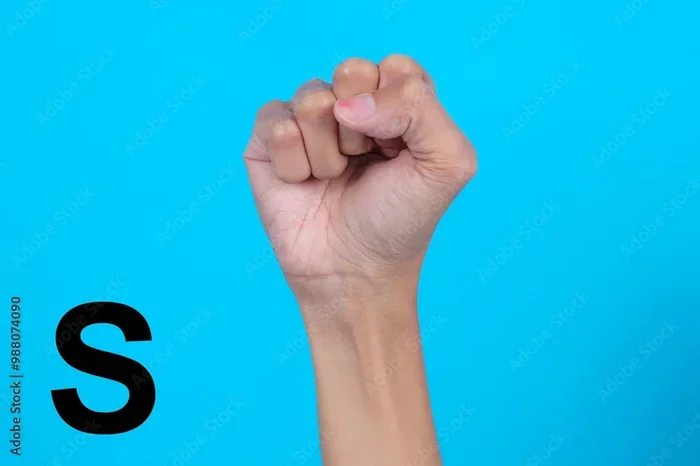
Learning how to say S in ASL is one of the first steps every beginner should take. The ASL letter S handshape is simple, versatile, and used in countless signs every day. This guide breaks down hand positioning, common errors, and practical exercises so you can sign S with confidence in no time.
Key Takeaways
- Handshape Matters: The ASL letter S uses a closed fist with your thumb resting gently over your fingers.
- Finger Spelling Is Key: Knowing how to say S in ASL helps you fingerspell words and communicate more effectively.
- Avoid Common Mistakes: Don’t let your thumb tuck inside your palm or spread your fingers too wide.
- Practice Daily: Short, consistent practice sessions build muscle memory faster than long sporadic ones.
- Use It in Context: The S handshape appears in many ASL signs beyond just the letter itself.
- Facial Expressions Help: Nonverbal cues add meaning and make your signing feel more natural.
📑 Table of Contents
- How to Say S in ASL: A Fun and Easy Guide for Beginners
- Understanding the ASL Letter S
- The Role of S in ASL Fingerspelling
- Practice Exercises to Master the S Handshape
- Where the S Handshape Appears in ASL Signs
- Tips for Faster Progress in Learning ASL
- Common Questions About the S Handshape in ASL
- Conclusion
How to Say S in ASL: A Fun and Easy Guide for Beginners
Have you ever wanted to learn sign language but felt overwhelmed by where to start? You are not alone. Thousands of people search for how to say s in asl every single day. The good news is that the letter S in American Sign Language is one of the simplest and most useful signs you will ever learn. Whether you are a curious beginner, a parent teaching your child, or someone who wants to communicate with deaf friends, this guide has you covered.
Signing is a beautiful form of nonverbal communication that opens doors to new relationships and experiences. The ASL alphabet, also known as fingerspelling, gives you the power to spell out any word using hand gestures. And it all starts with the basics. In this article, we will walk you through everything you need to know about signing the letter S. We will cover hand positioning, common mistakes, practice tips, and much more. By the end, you will feel confident enough to show off your new skill to friends and family.
Learning sign language for beginners does not have to be boring or complicated. In fact, it can be a lot of fun. Think of each sign as a small puzzle piece. Once you put enough pieces together, you can form full conversations. So let us dive right in and explore the world of ASL, starting with the letter S.
Understanding the ASL Letter S
The ASL letter S is formed by making a loose fist with your dominant hand. Your fingers curl inward, and your thumb rests gently on the outside of your index and middle fingers. It looks almost like you are holding a small ball. This handshape is called a “handshape” in sign language terminology, and it is one of the foundational building blocks of the entire ASL system.
Unlike spoken language, where letters are sounds, ASL letters are visual shapes. This means that how your hand looks matters just as much as where it is positioned in space. When you learn how to say s in asl, you are really learning a visual symbol that represents the letter S. This symbol is used in fingerspelling, which is the process of spelling out words letter by letter using hand gestures.
Fingerspelling is incredibly useful in real-life situations. You might use it to spell a person’s name, a brand name, or a word you do not know the sign for. Many ASL signs also use the S handshape as part of a larger gesture. So mastering this one handshape gives you a head start on many other signs too.
Hand Positioning for the Letter S
Let us break down the hand positioning step by step. This is the most important part of learning how to say s in asl correctly.
- Start with a relaxed hand. Hold your dominant hand out in front of you, palm facing slightly to the side.
- Curl your fingers inward. All four fingers should curl toward your palm, resting gently against the base of your fingers.
- Place your thumb. Lay your thumb flat across the front of your index and middle fingers. It should not tuck inside the fist or stick out too far.
- Keep your wrist straight. A relaxed wrist helps your handshape look clean and natural.
- Hold the position steady. When signing, stability matters. A shaky hand can make your sign hard to read.
Think of it like holding a tennis ball in your hand. Your fingers wrap around it gently, and your thumb rests on top. That is basically the S handshape. Once you get comfortable with this position, you can move on to using it in actual words and sentences.
Common Mistakes When Signing S
Even though the S handshape looks simple, beginners often make a few common errors. Here are the top mistakes to watch out for:
- Tucking the thumb inside the palm. This changes the handshape completely and can make your sign look like a different letter. Always keep the thumb visible on the outside.
- Spreading the fingers too wide. The S handshape should be compact. If your fingers are spread apart, it might look more like the letter A.
- Using the wrong hand. For right-handed people, the dominant hand is the right hand. Left-handed people should use their left hand. Consistency matters.
- Moving the whole arm instead of the hand. Most ASL letters stay still. The movement comes from the fingers and wrist, not the elbow or shoulder.
- Ignoring facial expressions. While the letter S itself does not require a specific expression, using your face during signing makes communication clearer and more engaging.
Avoiding these mistakes will save you a lot of frustration. If you are unsure whether your handshape is correct, try recording yourself on video and comparing it to a trusted ASL dictionary online. Seeing yourself sign is one of the fastest ways to improve.
The Role of S in ASL Fingerspelling
Now that you know how to form the S handshape, let us talk about how it fits into the bigger picture. ASL fingerspelling is the method of spelling words one letter at a time using handshapes from the ASL alphabet. The letter S is the nineteenth letter in the ASL alphabet and appears frequently in everyday signing.
When you fingerspell, you usually hold your hand at shoulder height and face the person you are communicating with. Each letter is formed clearly and in sequence. There is a natural rhythm to fingerspelling, almost like a gentle dance of the hands. The S handshape slots right into this rhythm, and because it is a compact, stable shape, it is easy to transition to and from other letters.
Here is a quick example. Imagine you want to fingerspell the word “sign.” You would form the S handshape, then transition to I, then N, then G. Each handshape flows into the next. The more you practice, the smoother these transitions become. Many people find that practicing fingerspelling with a friend makes the process feel less like study and more like a game.
You might also wonder about the connection between sign language and other forms of communication. For instance, some people ask about how gestures carry wyo meaning in text in digital conversations. While that is a different topic, it shows how hand signals and visual cues carry meaning across many platforms. Similarly, when you learn how to say s in asl, you are adding a visual symbol to your communication toolkit that works in real-time face-to-face interactions.
Practice Exercises to Master the S Handshape
Reading about a handshape is helpful, but practice is where real learning happens. Here are some fun and effective exercises to help you master the ASL letter S.
Exercise 1: The Five-Minute Fingerspelling Drill
Set a timer for five minutes. During that time, practice forming the S handshape over and over. Focus on consistency. Every time you form the handshape, check that your thumb is in the right position and your fingers are curled neatly. After the five minutes, try fingerspelling a short word that contains the letter S, such as “bus” or “rose.”
Exercise 2: The Mirror Check
Stand in front of a mirror and sign the letter S. Look at your handshape from the perspective of the person facing you. Does it look clear and clean? If something looks off, adjust your hand and try again. This simple exercise helps you self-correct without needing a teacher.
Exercise 3: The Object Labeling Game
Pick up everyday objects around your home and label them using the letter S. For example, hold up a spoon and sign S. Hold up a shoe and sign S. This game connects the handshape to real objects and makes practice feel playful. You can also involve family members or roommates to make it a group activity.
Exercise 4: Video Comparison
Find a video tutorial that demonstrates how to say s in asl. Watch the instructor form the S handshape slowly. Pause the video, try to replicate the handshape, and then compare your hand to the instructor’s. This method is especially useful for visual learners who benefit from seeing the correct form before attempting it themselves.
Remember, short daily practice sessions work better than long occasional ones. Even ten minutes a day can lead to noticeable improvement within a few weeks. The key is to stay consistent and make the practice enjoyable.
Where the S Handshape Appears in ASL Signs
The letter S is not just for fingerspelling. Many full ASL signs use the S handshape as a starting point or a key component. Here are a few examples:
- SIT: This sign uses a modified S handshape that moves downward in a gentle motion to indicate sitting.
- SWEET: The S handshape touches your lips and then moves outward, representing something sweet.
- SO-so: This sign uses both hands in S handshapes, moving outward from the chest to show an okay or moderate feeling.
- SAME: Both hands form S handshapes and move together, indicating that two things are the same.
As you can see, the S handshape is incredibly versatile. Once you learn how to form it correctly, you unlock access to a whole family of signs. This is one of the reasons why learning ASL starts with mastering the individual handshapes. Each one serves as a gateway to many more signs.
It is also worth noting that sign language is not just about the hands. Your body language, facial expressions, and even the space around you all play a role in communication. When you sign the letter S or any sign that uses the S handshape, try to keep your face relaxed and your expressions natural. This holistic approach to deaf communication is what makes ASL such a rich and expressive language.
Tips for Faster Progress in Learning ASL
Want to speed up your journey? Here are some expert-backed tips that can help you learn faster and retain more.
- Sign every day. Consistency beats intensity. Ten minutes daily is better than one hour once a week.
- Immerse yourself. Watch ASL videos, follow deaf creators on social media, and surround yourself with the language as much as possible.
- Find a signing partner. Practicing with another person makes learning feel less isolated and more interactive.
- Use flashcards. Write the letter on one side and the handshape description on the other. Quiz yourself regularly.
- Be patient with yourself. Everyone learns at their own pace. Celebrate small wins along the way.
Some people also find it helpful to explore the broader context of language and meaning. For example, many learners are curious about how different languages express concepts, which is why topics like translate to english in hindi meaning attract so much interest. Similarly, the journey of man’s search for meaning through language and communication is a deeply personal one, and ASL offers a unique visual pathway to that exploration. While these topics are different from how to say s in asl, they share a common thread: the human desire to connect and communicate.
Another interesting angle is understanding how meaning shifts across different communication methods. When people look up what something means in a text or online context, they often search for terms like in lieu of meaning to understand substitution and equivalence. In ASL, the S handshape substitutes for the spoken letter S, and fingerspelling substitutes for spoken words when no specific sign exists. This parallel shows how all forms of communication share common goals, even when the methods differ.
Common Questions About the S Handshape in ASL
Before we wrap up, let us address a few questions that beginners often ask about the letter S in American Sign Language.
Is the ASL S handshape the same as the English letter S?
Yes and no. The ASL S handshape represents the letter S in the ASL alphabet, but it is a visual gesture, not a written letter. The handshape is designed to be clear and readable from a distance, which is why the thumb placement and finger curl are so specific.
Can left-handed people sign the letter S differently?
Left-handed people should use their left hand as the dominant hand. The handshape itself is the same, but the orientation may feel more natural when mirrored. There is no “wrong” hand to use as long as the handshape is correct.
How long does it take to learn the ASL letter S?
Most beginners can learn the S handshape within a few minutes of practice. However, building muscle memory so that it feels automatic takes a few days of consistent practice. Do not rush the process. Let your hands get comfortable with the shape naturally.
Do I need to learn the whole ASL alphabet to sign S?
No. You can learn the letter S on its own and start using it right away. However, learning the full ASL alphabet gives you the ability to fingerspell any word, which greatly expands your communication skills.
Are there apps that can help me practice ASL handshapes?
Yes, there are several apps and websites dedicated to teaching ASL. Look for apps that offer video demonstrations and interactive quizzes. These tools can be a great supplement to your practice sessions.
Can children learn the ASL letter S easily?
Absolutely. Children often pick up sign language handshapes faster than adults because they are more comfortable with visual and physical learning. Many parents start teaching their kids basic ASL signs, including the alphabet, from a very young age.
Conclusion
Learning how to say s in asl is a rewarding first step into the world of American Sign Language. The S handshape is simple, versatile, and used in countless signs and fingerspelling sequences every day. By mastering the correct hand position, avoiding common mistakes, and practicing consistently, you can sign S with confidence and clarity.
Remember that every expert was once a beginner. The fact that you are taking the time to learn shows genuine interest in connecting with others through a beautiful and expressive language. Keep practicing, stay curious, and enjoy the journey. Before you know it, you will be fingerspelling full words and even forming complete sentences in ASL.
Start today. Grab your hands, form that S shape, and take the first step toward a whole new way of communicating. The world of sign language is waiting for you.