
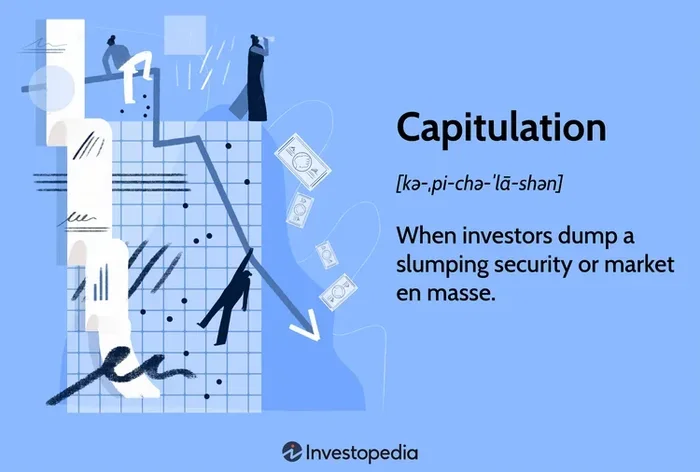
The capitulation meaning in finance refers to the moment when investors surrender and sell assets in panic, often signaling a market bottom. Understanding capitulation definition helps traders spot turning points, avoid emotional decisions, and find opportunities in bear market capitulation. Whether you invest in stocks or crypto, knowing what capitulation looks like can change your entire approach to the market.
Have you ever watched the stock market or crypto market drop like a stone and thought, “Is this the end?” You are not alone. Every investor has felt that gut-wrenching moment when prices keep falling and everyone around you seems to be panicking. But here is the thing — that panic has a name. It is called capitulation. And understanding capitulation meaning might just be the most valuable skill you can build as an investor.
In simple terms, capitulation happens when investors give up. They stop holding and start selling everything in sight. It is the point of total surrender. But what does that really mean for you? Why should you care about the capitulation definition if you are not a day trader? The answer is straightforward. Capitulation often marks the bottom of a market decline. It is the moment right before things start to turn around. And if you know how to spot it, you can make smarter decisions with your money.
This article breaks down capitulation meaning in plain language. We will walk through how it works in real markets, what signs to look for, and why it matters whether you invest in stocks, crypto, or anything else. By the end, you will have a clear picture of what capitulation in stocks and capitulation in cryptocurrency look like — and how to use that knowledge to your advantage.
Key Takeaways
- Capitulation meaning: It is the point where investors give up and sell aggressively, often marking a market bottom.
- Capitulation in stocks: Heavy selling pressure driven by fear, despair, and exhaustion among market participants.
- Capitulation in crypto: Crypto markets experience intense capitulation phases that create major buying opportunities.
- Capitulation signals: Volume spikes, capitulation candles, and extreme fear readings are key indicators.
- Capitulation investing: Smart investors watch for capitulation to enter positions at or near the bottom.
- Capitulation vs consolidation: These are very different market phases and understanding both helps you trade better.
- Key takeaway: Recognizing capitulation early gives you an edge in finding market reversals and avoiding further losses.
📑 Table of Contents
- What Is Capitulation? The Full Capitulation Definition
- How Capitulation Works in Financial Markets
- Capitulation Meaning in Stocks and Crypto
- Signs That Capitulation Is Happening
- Why Capitulation Matters for Investors
- How to React When Capitulation Hits
- Common Mistakes During Capitulation
- Expert Insights on Capitulation
- Key Takeaways
- Conclusion
What Is Capitulation? The Full Capitulation Definition
Let us start with the basics. The capitulation definition is simple. It means giving up completely. In a financial context, it refers to the point where investors stop fighting the market and start selling everything they hold. They “capitulate.” That word comes from the Latin word “capitulare,” which means to surrender or give over.
When we talk about capitulation meaning in the markets, we are describing a mass exit. It is not just one person selling. It is thousands or even millions of people giving up at the same time. They sell because they are scared, exhausted, or convinced that things will only get worse.
Think of it like this. Imagine you are holding a ball at the top of a hill. You let go, and it rolls down faster and faster. At some point, the ball hits the bottom and stops. That bottom — the lowest point — is like capitulation in the market. It is where the selling finally runs out of steam.
Why the Word “Capitulation” Matters
The word carries emotional weight. It is not a clinical term like “market correction.” It speaks to the human side of investing. Fear, despair, frustration, and hopelessness all come together during a capitulation event. This emotional component is what makes capitulation so important to understand. Markets are driven by people, and people act on emotion.
When you truly grasp capitulation meaning, you start to see the market differently. You stop reacting to every dip and start looking for the bigger picture. That shift in mindset can make a huge difference in your investment results.
How Capitulation Works in Financial Markets
Now that you know the capitulation definition, let us look at how it actually plays out in real markets. Capitulation does not happen in a vacuum. It builds over time through a series of events that push investors to their breaking point.
The Phases Leading to Capitulation
Most capitulation phases follow a predictable pattern. Understanding these phases helps you recognize where you are in the cycle.
- Denial: Prices start falling. Investors tell themselves it is just a dip. They hold on tight.
- Fear: The drop continues. News gets worse. Investors start to worry but still hold.
- Panic: Prices fall fast. People start selling. The fear becomes contagious.
- Capitulation: Investors give up entirely. They sell everything at any price. This is the bottom.
- Relief: The selling stops. Prices stabilize. A new phase begins.
Each phase feeds into the next. The longer the decline lasts, the more intense the capitulation becomes. This is why long bear markets often produce the strongest buying opportunities.
The Role of Fear and Greed
You have probably heard the phrase “fear and greed” in investing. During a capitulation event, fear is the dominant force. The fear and greed index often hits extreme levels during these periods. When fear takes over completely, rational thinking goes out the window. People sell not because they have analyzed the market, but because they are terrified of losing more.
This is exactly why capitulation matters. The most emotional selling happens at the worst possible time — near the bottom. Investors who understand capitulation meaning can stay calm when everyone else is panicking.
Capitulation Meaning in Stocks and Crypto
Capitulation happens across all types of markets. But the way it shows up can differ depending on what you are trading. Let us look at capitulation in stocks and capitulation in cryptocurrency separately.
Capitulation in Stocks
In the stock market, capitulation in stocks often happens during bear markets or severe corrections. You see it when major indexes like the S&P 500 or the Dow Jones drop sharply and then experience huge volume spikes on down days. The capitulation candle is a specific chart pattern that traders watch for.
A capitulation candle is a single day or session where the market drops dramatically on massive volume. It shows that everyone who wanted to sell has finally sold. This can be a powerful signal that the worst is over.
Historically, some of the best stock market bottoms have been preceded by intense capitulation. The 2008 financial crisis, the 2020 COVID crash, and the dot-com bubble all featured clear capitulation moments. Investors who bought at those bottoms saw enormous gains over the following years.
Capitulation in Cryptocurrency
Capitulation in cryptocurrency follows a similar pattern but with some unique twists. Crypto markets are more volatile than traditional stock markets. This means crypto capitulation can happen faster and more intensely.
When Bitcoin or Ethereum drops 50% or more, the crypto community often enters a full-blown capitulation phase. Social media fills with negative sentiment. Long-term investors give up. Newcomers get scared away. And then, just like in stocks, the selling exhausts itself.
The capitulation index for crypto has become a popular tool. It tracks on-chain data like exchange inflows, active addresses, and realized losses to measure how close the market is to a capitulation point. These tools help investors identify when crypto capitulation might be nearing its end.
Capitulation vs Consolidation
It is important to distinguish capitulation vs consolidation. These are two very different things. Consolidation is when prices move sideways after a decline. The market is resting and absorbing the previous drop. Capitulation, on the other hand, is active, emotional, and heavy selling.
Consolidation can last weeks or months. Capitulation usually happens over days or even hours. Confusing the two can lead to bad investment decisions. Make sure you know which phase the market is in before making any moves.
Signs That Capitulation Is Happening
Knowing the capitulation definition is one thing. Spotting it in real time is another. Fortunately, there are clear signs that a capitulation phase is underway. Learning to recognize these signs can give you a real edge.
Volume Spikes
One of the most reliable capitulation signals is a massive spike in trading volume. When everyone is selling at once, volume goes through the roof. This is not normal trading activity. This is panic selling in action.
If you see a day where volume is two or three times the average and the price drops sharply, that is a strong capitulation indicator. It means the weak hands are finally out of the market.
Extreme Fear Readings
The fear and greed index is a popular tool for measuring market sentiment. When it drops into extreme fear territory, that often coincides with capitulation. Other sentiment tools, like social media analysis and news sentiment scores, also show extreme negativity during these periods.
But here is the key insight. Extreme fear is often a contrarian buy signal. When everyone is terrified, that is when the best opportunities can emerge.
Capitulation Candles and Chart Patterns
Technical traders look for specific chart patterns during capitulation. A capitulation candle is the most well-known. It is a large red or bearish candle with very long lower wicks. The wick shows that sellers pushed the price down hard, but buyers stepped in aggressively at the low.
Other patterns include hammer candles, doji candles at major support levels, and gaps down followed by gap fills. Each of these can signal that capitulation in stocks or crypto is reaching its peak.
Negative News Everywhere
During a capitulation event, the news is almost always terrible. Headlines scream about crashes, recessions, and financial doom. Analysts downgrade everything. Even usually optimistic commentators turn bearish.
This flood of negativity is actually a clue. When the news is at its worst, the market is often closest to the bottom. The people who understand capitulation meaning see this as a sign, not a reason to panic.
Why Capitulation Matters for Investors
You might be thinking, “Okay, I understand capitulation meaning now. But why does it matter to me?” The answer depends on your investment style and goals.
Capitulation Investing: Finding the Bottom
Capitulation investing is a strategy where investors look for capitulation signals to time their entries. The idea is simple. When everyone is selling in panic, quality assets get unfairly cheap. If you have the courage to buy during a capitulation phase, you can get in at or near the lowest prices.
This is not easy. It goes against human nature. Most people feel like buying when prices are rising and selling when they fall. Capitulation investing asks you to do the opposite. It asks you to buy when everyone else is running for the exits.
Avoiding Further Losses
Understanding capitulation meaning also helps you avoid throwing good money after bad. If you can recognize that a market is in a capitulation phase, you know that the selling pressure is extreme. This knowledge can help you avoid panic selling yourself. Instead, you can hold steady and wait for the market to find its footing.
Many investors lock in huge losses because they sell at the worst possible moment. They do not realize that what they are experiencing is classic capitulation. They just feel fear. Education changes that.
Building Long-Term Wealth
The investors who build the most wealth over time are not the ones who avoid downturns. They are the ones who understand how downturns work. They know that bear market capitulation is a normal part of the market cycle. They prepare for it. And when it arrives, they have a plan.
Capitulation is not the enemy. It is a natural part of how markets work. Embracing capitulation meaning helps you see downturns as opportunities rather than disasters.
How to React When Capitulation Hits
So you have recognized that capitulation is happening. What should you do? Here are some practical steps to consider.
1. Stay Calm and Stick to Your Plan
The worst thing you can do during a capitulation event is make emotional decisions. If you have a long-term investment plan, stick to it. Do not check your portfolio every five minutes. Do not make snap decisions based on fear.
Remember, capitulation is temporary. The market always moves in cycles. What goes down eventually comes back up.
2. Look for Quality Assets at a Discount
If you have cash available, a capitulation phase can be a great time to buy quality assets at a discount. Focus on strong companies or projects with solid fundamentals. The price drop does not change the long-term value of a good investment.
3. Do Not Try to Catch the Exact Bottom
One common mistake is trying to buy at the absolute bottom. In reality, no one can predict the exact bottom with certainty. Instead, think about buying in stages. Put some capital to work during capitulation and add more as the market shows signs of recovery.
4. Watch for Capitulation Signals
Use the capitulation signals we discussed earlier. Volume spikes, extreme fear readings, and capitulation candles can help you gauge where you are in the process. This information helps you make more informed decisions.
5. Protect Your Portfolio
If you are already heavily invested and worried about further losses, consider protective strategies. Diversification, stop-loss orders, and hedging can all help you manage risk during a capitulation phase. The goal is to preserve capital while staying positioned for the recovery.
Common Mistakes During Capitulation
Even experienced investors make mistakes during capitulation events. Here are some pitfalls to avoid.
- Panic selling: Selling everything at the bottom locks in your losses. This is the most common and costly mistake.
- Waiting too long: Some investors hesitate to buy during capitulation because they fear the market could drop further. This can cause you to miss the best entry points.
- Ignoring fundamentals: During heavy selling, even strong companies get swept lower. Do not confuse a temporary price drop with a broken business.
- Following the crowd: If everyone is selling, it does not mean you should too. Contrarian thinking is often rewarded during capitulation.
- Using money you cannot afford to lose: Buying during a capitulation phase should only be done with funds you can leave invested for the long term.
Expert Insights on Capitulation
Seasoned investors and traders often talk about capitulation meaning in very practical terms. Warren Buffett once said, “Be fearful when others are greedy, and greedy when others are fearful.” That quote captures the essence of capitulation investing perfectly.
Professional traders also emphasize that capitulation in stocks is not a single event. It is a process. It builds over days or weeks. The key is patience. You do not need to predict the exact bottom. You just need to recognize the process and position yourself accordingly.
Crypto traders often mention that crypto capitulation can be especially brutal because of the market’s higher volatility. But the same principles apply. When the selling finally stops and the capitulation candle appears, that is often the beginning of a new uptrend.
Market analysts also point out that capitulation is different from a normal market correction. A correction is a healthy pullback. Capitulation is an emotional breakdown of selling. Understanding this distinction helps you respond appropriately to each situation.
One expert insight worth repeating: capitulation is not something to fear. It is something to understand. Once you understand capitulation meaning, you stop being a victim of market swings and start becoming an active participant in the market cycle.
Key Takeaways
- Capitulation meaning: It is the moment when investors surrender and sell aggressively, often signaling a market bottom.
- Capitulation in stocks: Heavy selling pressure driven by fear, despair, and exhaustion among market participants.
- Capitulation in crypto: Crypto markets experience intense capitulation phases that create major buying opportunities.
- Capitulation signals: Volume spikes, capitulation candles, and extreme fear readings are key indicators.
- Capitulation investing: Smart investors watch for capitulation to enter positions at or near the bottom.
- Capitulation vs consolidation: These are very different market phases and understanding both helps you trade better.
- Key takeaway: Recognizing capitulation early gives you an edge in finding market reversals and avoiding further losses.
Conclusion
Understanding capitulation meaning is one of the most valuable things you can do as an investor. It gives you a framework for interpreting market panic. It helps you separate emotion from logic. And it opens the door to opportunities that most people miss because they are too scared to act.
The next time you see the market drop sharply and hear everyone around you panicking, remember what you have learned. That is not the end. That is often the beginning. Capitulation in stocks and capitulation in cryptocurrency are natural parts of the market cycle. They create the conditions for strong recoveries and significant gains.
Use the capitulation signals and capitulation indicators discussed in this article to sharpen your market awareness. Build a plan. Stay disciplined. And when the capitulation phase arrives, be ready. The investors who understand capitulation meaning are the ones who find the best opportunities when others are running for the exits.
The market will always go up and down. That is the nature of investing. But with the right knowledge and the right mindset, you can navigate those ups and downs with confidence. Start paying attention to capitulation in the markets. It might just change the way you invest forever.
Frequently Asked Questions
What does capitulation mean in simple terms?
In simple terms, capitulation meaning is when investors give up and sell everything they hold because they are scared or exhausted. It usually happens near the bottom of a market decline and can signal that the worst selling is over.
How do you know when capitulation is happening?
You can spot a capitulation event by watching for volume spikes, extreme fear readings on sentiment tools, and specific chart patterns like a capitulation candle. Negative news is everywhere, and even long-term investors start to panic sell. These are all strong capitulation signals.
Is capitulation good or bad for investors?
Capitulation itself is neither good nor bad. It is a market phase. But it creates opportunities for investors who understand capitulation in stocks or capitulation in cryptocurrency. Smart investors see capitulation as a potential buying opportunity near market bottoms.
What is the difference between capitulation and a market correction?
A market correction is a normal, healthy pullback of 10% or more from recent highs. Capitulation is an emotional breakdown where mass selling happens on panic and fear. Capitulation is usually more intense and shorter in duration than a typical correction. Understanding capitulation vs consolidation and corrections helps you respond correctly to each market phase.
Can capitulation happen in crypto markets?
Yes, capitulation in cryptocurrency is very common. Crypto markets are highly volatile, which means crypto capitulation can happen faster and more intensely than in traditional stock markets. Bitcoin and Ethereum have experienced multiple major capitulation phases throughout their history.
What should I do when capitulation hits my portfolio?
Stay calm and stick to your investment plan. Do not panic sell. If you have cash available, consider whether quality assets are now available at a discount. Use capitulation investing principles to make thoughtful decisions rather than emotional ones. Remember that capitulation phases are temporary and often precede market recoveries.