
Learning how to say 50 in french is simple and rewarding. The French word for 50 is cinquante, and once you understand the pattern behind French numbers, counting to 50 and beyond becomes much easier. This guide breaks down pronunciation, spelling, and practical usage so you can start using fifty in french confidently right away.
Have you ever found yourself staring at a French text and stumbled on the number 50? You are not alone. Learning how to say 50 in french is one of those small wins that builds real confidence. Whether you are traveling to Paris, chatting with a French friend, or just curious about the language, knowing your numbers is essential.
The good news is that fifty in french is actually quite simple. The word is cinquante, and once you get the hang of how French numbers work, you will find that counting to 50 and beyond follows a logical pattern. This guide walks you through everything you need to know, from pronunciation to real-life usage.
French numbers might seem tricky at first, but they follow rules. Once you understand the system, you will start recognizing patterns everywhere. Think of it like learning a new song once you know the chorus, the verses come naturally. So let us dive in and make learning how to count in french fun and easy.
Key Takeaways
- Cinquante is the French word for 50: It follows a straightforward pattern once you know the basics of French counting.
- Pronunciation is key: The correct way to say cinquante sounds like “san-KAHNT” with a soft ending.
- French number patterns repeat: Understanding the structure helps you learn all numbers up to 100 faster.
- Practice with real sentences: Using cinquante in everyday phrases builds fluency and confidence.
- Common mistakes are easy to avoid: Watch out for spelling traps and false friends from English.
- Consistent daily practice works best: Even five minutes a day can dramatically improve your French number skills.
📑 Table of Contents
What Is 50 in French?
The French word for 50 is cinquante. It is spelled c-i-n-q-u-a-n-t-e. At first glance, it might look a bit long, but once you break it down, it is very manageable. The word comes from the Latin “quinquaginta,” which also gives us the English word “fifty.” So there is already a connection you can lean on.
When you say cinquante, the pronunciation is “san-KAHNT.” The “c” sounds like an “s,” the “in” blends into a soft nasal sound, and the “ante” ending is pronounced like “ahnt.” It is one syllable sound, smooth and steady.
Pronunciation Tips for Cinquante
French pronunciation can feel intimidating, but cinquante is actually one of the friendlier numbers. Here are some quick tips to get it right:
- Break it into parts: Think of it as “san” + “KAHNT.” This makes it easier to tackle.
- Keep the ending soft: The “t” at the end is silent or barely whispered. Do not pronounce it like an English “t.”
- Nasal sounds matter: French has many nasal vowels. The “in” in cinquante has a slight nasal quality. Practice saying “san” with air flowing through your nose.
- Listen and repeat: Use apps or YouTube videos to hear native speakers. Mimicking them is one of the fastest ways to improve.
If you are working on French vocabulary for travel or study, getting the pronunciation of cinquante right will make a big difference. French speakers appreciate effort, and a good attempt goes a long way.
Understanding the French Number System
To truly master how to say 50 in french, you need to understand how the French number system works. French numbers follow a base-10 structure, much like English, but with some unique twists that make them interesting.
Numbers 1 Through 20
Before you can reach 50, you need a solid foundation in the smaller numbers. Here is a quick look at the building blocks:
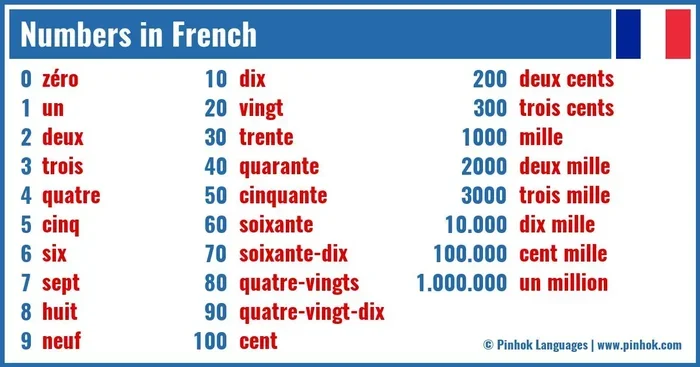
- 1 to 10: un, deux, trois, quatre, cinq, six, sept, huit, neuf, dix
- 11 to 20: onze, douze, treize, quatorze, quinze, seize, dix-sept, dix-huit, dix-neuf, vingt
Notice how numbers 11 through 16 end in “-ze” and 17 through 19 start with “dix-” meaning ten. Vingt means 20, and it is the key stepping stone to larger numbers. Once you know 1 through 20, you have the tools to build every number up to 100.
How Numbers 20 to 69 Work
This is where the pattern gets exciting. In French, numbers 21 through 69 use a combination of the tens and the ones:
- 21: vingt et un (twenty and one)
- 30: trente (thirty)
- 40: quarante (forty)
- 50: cinquante (fifty)
- 60: soixante (sixty)
To make numbers like 53, you simply add the ones place to cinquante. So 53 becomes cinquante-trois (fifty-three). The pattern is consistent and logical. Once you know the tens words, building any number is just a matter of combining them.
The Unique French Counting Quirk
Here is something interesting about French counting. In some French-speaking regions, the number system works differently than you might expect. For example, in Belgium and Switzerland, 70 is “septante,” 80 is “huitante,” and 90 is “nonante.” But in standard French, 70 is “soixante-dix” (sixty-ten), 80 is “quatre-vingts” (four-twenties), and 90 is “quatre-vingt-dix” (four-twenties-ten).
This quirk can be confusing, but it also shows how creative the French language is. The base-20 system has roots going back centuries. Understanding this gives you deeper insight into how French numbers evolved and why they work the way they do.
How to Use Cinquante in Everyday Sentences
Knowing the word is one thing. Using it naturally is another. Let us look at how cinquante fits into real conversations and sentences.
Talking About Age
One of the most common uses of any number is stating your age. In French, you would say:
- J’ai cinquante ans. (I am fifty years old.)
- Elle a cinquante ans. (She is fifty years old.)
The structure is simple: “J’ai” (I have) + the number + “ans” (years). This pattern works for any age, so once you know how to say 50 in french, you can talk about age confidently.
Discussing Time
Numbers come up constantly when telling time. If it is 50 minutes past the hour, you would say:
- Il est une heure cinquante. (It is fifty past one.)
Using cinquante in time expressions helps you sound more natural and fluent. Practice saying different times with various numbers to build your confidence.
Talking About Money
Whether you are shopping in a French market or discussing prices, numbers matter. You might say:
- Cela coûte cinquante euros. (That costs fifty euros.)
- J’ai cinquante dollars. (I have fifty dollars.)
Being able to handle numbers in financial conversations is a practical skill that comes up often. When you can fluently say fifty in french, you handle transactions with ease.
Common Mistakes When Saying 50 in French
Every language learner makes mistakes, and that is perfectly fine. But some common errors can slow down your progress. Here is what to watch out for when learning how to say 50 in french.
Mistake 1: Pronouncing the Final “t”
Many English speakers accidentally pronounce the “t” at the end of cinquante. In French, this “t” is silent. The word ends with a soft “nt” sound, not a hard “t.” If you say “san-KAHN-tay” with a clear “t,” it will sound unnatural to native speakers.
Mistake 2: Confusing Cinquante with Quarante
Cinquante (50) and quarante (40) look similar in spelling, but they sound quite different. Quarante is “kah-RAHNT” and cinquante is “san-KAHNT.” Mixing these up can lead to confusion, so practice them side by side until they feel natural.
Mistake 3: Forgetting the Hyphen
When combining cinquante with a ones digit, you need a hyphen. For example, 51 is “cinquante-et-un” and 53 is “cinquante-trois.” Some learners forget the hyphen or use “et” incorrectly. In modern French, “cinquante et un” is still used for 51, but other numbers like 52 simply use a hyphen: “cinquante-deux.”
Mistake 4: Translating Word for Word
Sometimes learners try to directly translate English number structures into French. This does not always work. For instance, the way English handles “fifty-one” (fifty + one) differs slightly from how French handles “cinquante et un.” Always learn the French structure rather than translating directly.
Fun Ways to Practice Saying 50 in French
Practice does not have to be boring. There are many enjoyable ways to reinforce your knowledge of cinquante and build your overall French number skills.
Try Flashcards
Write the number on one side of a card and the French word on the other. Quiz yourself daily. Start with numbers 1 through 50 and gradually expand. Flashcards are a proven method for memorization, and they take just a few minutes each day.
Use Language Apps
Apps like Duolingo, Babbel, or Memrise offer number exercises in French. These apps use spaced repetition, which means they show you numbers at the right time to help you remember them longer. Practicing with an app makes learning French numbers feel like a game rather than a chore.
Watch French Videos
YouTube channels and French learning podcasts often include number counting exercises. Listening to native speakers say cinquante in context helps you pick up the natural rhythm and flow of the language. Try to mimic what you hear, even if you start slowly.
Practice with a Partner
Find a language exchange partner or join a French conversation group. Practicing with real people makes the experience more engaging. You can quiz each other on numbers, play counting games, or simply have a conversation that naturally includes numbers.
Count in French During Daily Activities
Here is a simple habit that works wonders. Count your steps, your grocery items, or the minutes until an event — all in French. This kind of immersive practice helps you internalize numbers without even trying. Before long, saying fifty in french will feel as natural as saying “fifty” in English.
Quick Reference: Numbers Around 50
Having a quick reference table helps you see the pattern clearly. Here are the numbers surrounding 50 in French:
- 45: quarante-cinq
- 46: quarante-six
- 47: quarante-sept
- 48: quarante-huit
- 49: quarante-neuf
- 50: cinquante
- 51: cinquante et un
- 52: cinquante-deux
- 53: cinquante-trois
- 54: cinquante-quatre
- 55: cinquante-cinq
- 56: cinquante-six
- 57: cinquante-sept
- 58: cinquante-huit
- 59: cinquante-neuf
- 60: soixante
Notice how clean the pattern is. The tens word stays the same, and you just add the ones digit with a hyphen. This consistency is what makes French numbers learnable once you grasp the basics.
Expert Insights on Learning French Numbers
Language experts agree that numbers are one of the best starting points for any new language. They follow clear patterns and appear in daily life constantly. When you learn how to say 50 in french, you are not just memorizing a single word. You are building a foundation for understanding the entire French number system.
One common tip from polyglots is to group numbers by tens. Master 10, 20, 30, 40, 50, and so on first. Then learn the ones digits. Finally, practice combining them. This method, sometimes called the chunking technique, makes large sets of numbers feel manageable.
Another insight is to connect numbers to real-life situations. When you practice saying “cinquante euros” or “cinquante minutes,” you are not just memorizing a word. You are attaching meaning to it, which makes recall much faster and more reliable.
Also, remember that translation is a skill that improves with practice. If you ever want to explore how different languages handle the concept of “translate to english in hindi meaning” or similar cross-language challenges, you will find that understanding number systems is a great bridge between languages. The same applies when you encounter terms like “wyo meaning in text” or “in lieu of meaning” — every language has its own way of expressing ideas, and numbers are often the most universal starting point.
Keep your practice sessions short and positive. Even ten minutes a day builds momentum. Celebrate small wins like mastering cinquante and moving on to bigger numbers. Progress in language learning is cumulative, and every new number you learn brings you closer to fluency.
Key Takeaways
- Cinquante is the French word for 50: It follows a straightforward pattern once you know the basics of French counting.
- Pronunciation is key: The correct way to say cinquante sounds like “san-KAHNT” with a soft ending.
- French number patterns repeat: Understanding the structure helps you learn all numbers up to 100 faster.
- Practice with real sentences: Using cinquante in everyday phrases builds fluency and confidence.
- Common mistakes are easy to avoid: Watch out for spelling traps and false friends from English.
- Consistent daily practice works best: Even five minutes a day can dramatically improve your French number skills.
Conclusion
Learning how to say 50 in french is a rewarding step in your language journey. The word cinquante is simple to pronounce, easy to spell, and fits naturally into everyday conversations. From talking about your age to discussing prices and time, this number shows up everywhere in French daily life.
By understanding the French number system, avoiding common mistakes, and practicing regularly, you will find that counting in french becomes second nature. The patterns are logical, the pronunciation is smooth, and the practical applications are endless.
Remember that every language learner starts with small steps. Mastering fifty in french today gives you the confidence to tackle bigger numbers tomorrow. Keep practicing, stay curious, and enjoy the process of learning one of the world’s most beautiful languages.
So go ahead and say it out loud: cinquante. Feel the word on your tongue. Say it a few times. Soon it will be as natural to you as counting to fifty in your own language. You have got this.
Frequently Asked Questions
What is the French word for 50?
The French word for 50 is cinquante. It is pronounced “san-KAHNT” and is spelled c-i-n-q-u-a-n-t-e. Once you learn this word, you can use it in age, time, and money conversations with ease.
How do you pronounce cinquante correctly?
To pronounce cinquante, say “san-KAHNT.” The “c” makes an “s” sound, the “in” is a soft nasal vowel, and the final “t” is silent or barely whispered. Practice saying it slowly at first, then speed up as it becomes comfortable.
Is learning French numbers hard?
Not at all! French numbers follow a logical pattern based on tens and ones. Once you learn the base words for 1 through 20 and the tens words (like cinquante for 50), you can build any number up to 100. Consistency and daily practice make it even easier.
How is 50 different from 40 in French?
The French word for 40 is “quarante” (pronounced “kah-RAHNT”), while 50 is “cinquante” (pronounced “san-KAHNT”). They look similar in spelling but sound quite different. Focus on the beginning sounds to tell them apart easily.
Can I use cinquante in everyday conversations?
Absolutely! You can use cinquante when talking about age, time, money, addresses, and more. For example, “J’ai cinquante ans” means “I am fifty years old.” Using numbers in real conversations helps you remember them faster.
What are some tips for memorizing French numbers?
Use flashcards, practice with language apps, count during daily activities, and listen to native speakers. Grouping numbers by tens and practicing them in real sentences are also highly effective techniques for long-term retention.
=== INTERNAL LINKS ===
If you are curious about how words carry different meanings across languages, you might enjoy learning more about the translate to english in hindi meaning to understand cross-language connections.
Sometimes abbreviations and shorthand like wyo meaning in text can also confuse language learners, but understanding context makes all the difference.
When you want to express something using an alternative phrase, knowing the in lieu of meaning helps you navigate formal and informal French conversations with greater flexibility.