
Learning how to say question in ASL is simpler than you think. This guide covers everything from yes/no questions to WH-questions, facial expressions, and non-manual markers. You will walk away with practical tips and real examples to start signing questions confidently.
Have you ever wondered how to say question in ASL? Maybe you are just starting your journey into American Sign Language, or perhaps you know a few basic signs and want to go deeper. Either way, you are in the right place. Questions are a fundamental part of any language, and ASL is no different.
Asking questions in sign language looks very different from speaking them out loud. Your face, your eyebrows, and even your head position all play a huge role. In this guide, we will break down everything you need to know about forming questions in ASL. You will learn the basics, practice real examples, and avoid common mistakes along the way.
American Sign Language is a rich, visual-gestural language used by the deaf community across North America. It relies on hand shapes, movement, location, and expression to convey meaning. When you add a question to the mix, your entire body becomes part of the message. Let us dive in and explore how this works.
Key Takeaways
- Facial expressions are essential: They act as question markers in ASL and change the meaning of your signs entirely.
- Yes/no questions use specific eyebrow movements: Raised eyebrows signal a yes/no question in ASL.
- WH-questions need head tilts: Words like who, what, and where require a forward head tilt and furrowed brows.
- Word order differs from English: ASL questions often follow a Subject-Verb-Object structure with question markers at the end.
- Practice with real conversations: The best way to learn is by signing with native ASL users or in deaf community settings.
- Non-manual signals are not optional: Skipping facial cues will make your questions confusing or incorrect.
- Start with simple phrases: Build your confidence by mastering basic question forms before moving to complex ones.
📑 Table of Contents
Understanding How Questions Work in ASL
Before you start practicing, it helps to understand the basic mechanics of question formation in ASL. Unlike English, where we often use helper words like “do” or “does,” ASL uses facial expressions and word order to signal a question. This is one of the biggest differences beginners notice right away.
In spoken English, you might say, “Do you like pizza?” In ASL, you would sign “YOU LIKE PIZZA?” with a specific facial expression. The question mark lives in your expression, not in extra words. This makes ASL questions feel elegant and efficient once you get the hang of them.
Yes/No Questions in ASL
Yes/no questions are the simplest type of question in any language. In ASL, you form them by raising your eyebrows and tilting your head slightly forward. The sign order usually stays the same as a statement, but your facial expression changes everything.
For example, to ask “Do you like pizza?” you would sign:
- YOU — point toward the person
- LIKE — use your dominant hand with a inward motion
- PIZZA — make a pizza gesture with both hands
- Raise your eyebrows — this is the key question marker
That is it. No extra words. No helper verbs. Just signs and expression. Once you get comfortable with this pattern, you can ask countless yes/no questions in sign language for beginners practice.
WH-Questions in ASL
WH-questions ask for specific information. These include words like who, what, when, where, why, and how. In ASL, WH-questions require a different set of facial cues compared to yes/no questions.
For WH-questions, you need to:
- Furrow your eyebrows — bring them together and downward
- Tilt your head forward — slightly tuck your chin
- Hold the last sign — maintain the final hand shape and hold it
- Lean your body slightly forward — show engagement and curiosity
When you ask “What is your name?” in ASL, you would sign “YOUR NAME WHAT?” with furrowed brows and a head tilt held through the final sign. The question word usually comes at the end of the sentence in ASL, which surprises many new learners.
Non-Manual Markers: The Secret to ASL Questions
Here is where things get really interesting. Non-manual markers are facial expressions and body movements that change the meaning of your signs. They are not optional in ASL. Think of them as the punctuation marks of sign language.
Without non-manual markers, your signs are just individual words. Add the right expression, and suddenly you have a full question. It is like going from a sentence with no period to one with a clear question mark at the end.
Eyebrow Movements
Your eyebrows are the most powerful tool you have for ASL questions. There are two main positions:
- Raised eyebrows — used for yes/no questions. Think of the expression you make when you say “Really?” with genuine curiosity.
- Furrowed eyebrows — used for WH-questions. This is the focused, searching look you give when you want specific information.
Getting these right makes a massive difference. A beginner might sign all the correct words but still confuse listeners because their eyebrows say the wrong thing. Practice in front of a mirror until the expressions feel natural.
Head and Body Position
Beyond your eyebrows, your head tilt and body lean matter too. A slight forward tilt shows you are actively seeking information. Your eyes should also focus on the person you are signing with. This visual connection is what makes ASL a truly visual-gestural language.
Some learners also use shoulder shifts to indicate different subjects in a question. For instance, if you are asking “Did HE or SHE go?” you might shift your shoulders left and right while signing each option. These small details add clarity and richness to your questions.
Common ASL Question Words
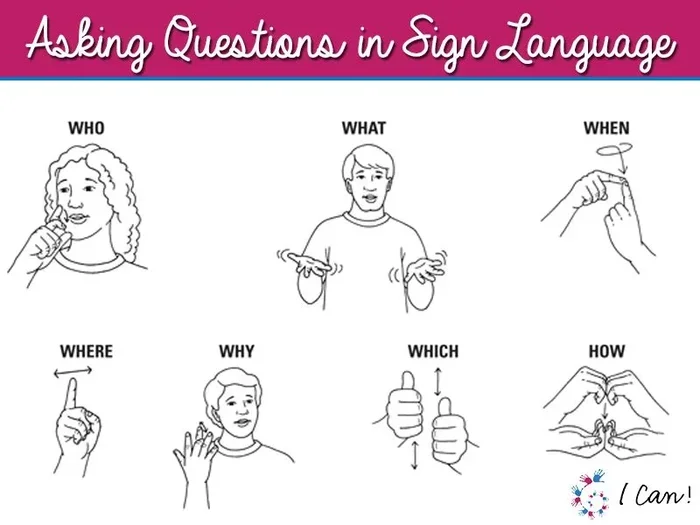
Just like in English, ASL has specific signs for question words. Learning these will open up a world of conversational possibilities. Here are the most common ones you should start with:
| English Word | ASL Sign Description | Usage Tip |
|---|---|---|
| Who | Index finger points forward, moves in small circles near the temple | Use furrowed brows and head tilt |
| What | Both hands open, palms up, shrug shoulders | Hold the final position |
| When | Index finger taps the wrist (like checking a watch) | Combine with raised or furrowed brows depending on context |
| Where | Index finger points down, moves in a small arc | Lean forward slightly |
| Why | Tapping the chest with the dominant hand’s middle finger | Use deep furrowed brows for emphasis |
| How | Open hands, palms facing up, moving outward | Great for asking about feelings or processes |
Each of these question words follows the same ASL sentence structure rules. You build the sentence around the person or topic, then place the WH-word at the end. This might feel backwards at first if you are used to English, but it becomes second nature with practice.
Putting Question Words Together
Let us look at a few full examples to see how this works in practice:
- “Where do you live?” — Sign “YOU LIVE WHERE?” with furrowed brows and a head tilt held through “WHERE.”
- “When did you arrive?” — Sign “YOU ARRIVE WHEN?” with the same facial cues.
- “How are you?” — Sign “YOU HOW?” with slightly raised eyebrows for a casual, friendly tone.
Notice how the word order stays consistent. The only thing that changes is your facial expression and the question word itself. This consistency is what makes ASL grammar rules logical and learnable.
Practice Tips for Beginners
Now that you understand the theory, let us talk about practice. Learning how to say question in ASL requires repetition, real-world interaction, and patience. Here are some tips that actually work.
1. Practice in Front of a Mirror
This is the single best exercise for beginners. Stand in front of a mirror, sign a simple question, and watch your face. Are your eyebrows raised or furrowed? Is your head tilted? Do you look like you are asking a question? If not, adjust and try again.
Mirror practice helps you build muscle memory for facial expressions. Over time, the correct expressions will start to feel automatic. You will not have to think about your eyebrows because they will just move naturally.
2. Record Yourself
Use your phone to record short signing clips. Watch them back and check your facial expressions and hand shapes. You will notice things you miss in real time. This is a trick used by many learn ASL online students, and it works incredibly well.
Try recording yourself asking three different questions each day. Mix yes/no questions with WH-questions. Review the footage and compare your expressions to those of native signers online.
3. Sign with Native Users
There is no substitute for real conversation. Find local deaf community events, join online ASL practice groups, or partner with a fluent signer for regular practice sessions. The feedback you get from native users is invaluable.
When you make mistakes, native signers are usually very patient and helpful. They can correct your expressions in real time, which speeds up your learning dramatically. Plus, signing with real people keeps you motivated and engaged.
4. Start with Simple Daily Questions
Do not try to master complex questions right away. Begin with everyday phrases like:
- “What is your name?”
- “Are you hungry?”
- “Where are you going?”
- “How old are you?”
- “Do you have a pen?”
Once these feel comfortable, you can gradually move to more complex questions. Building a strong foundation is the key to fluency in any language, including ASL question markers and their usage.
Common Mistakes Beginners Make
Every learner makes mistakes, and that is completely fine. But some errors come up so often that it is worth addressing them early. Here are the most common ones I see with new ASL students.
Forgetting Facial Expressions
This is the number one mistake. Learners focus so hard on hand signs that they forget their face. Without the right expression, your question simply does not register as a question. A statement and a question can use the exact same hand signs — the only difference is your face.
Think of it this way: if you said “You like pizza” in a flat, monotone voice in English, it would not sound like a question. The same principle applies in ASL. Your face carries the grammatical weight.
Using English Word Order
It is tempting to sign “WHAT YOUR NAME” because that matches the English order. But in ASL, it should be “YOUR NAME WHAT.” Breaking the English habit takes time, but once you do, your signing becomes much more natural and fluent.
Overcomplicating Things
ASL is beautifully simple in many ways. You do not need extra words or helper verbs to form questions. Trust the system. Raise your eyebrows, tilt your head, and let the signs do the work. Overcomplicating your sentences will slow you down and make you sound less natural.
Some learners try to translate directly from other languages they speak. For instance, when exploring cross-language communication, people often wonder about translate to English in Hindi meaning and how different languages handle questions differently. While interesting, this comparison should not distract you from mastering ASL’s own elegant question structure. Each language has its own logic, and ASL’s visual approach is uniquely powerful.
Skipping the Hold
In WH-questions, you must hold the final sign. This is not optional. Many beginners rush through the last sign, which makes the question feel incomplete. Hold that final hand shape, keep your expression, and let the person you are signing with process the question fully.
Expert Insights on ASL Question Formation
Experienced ASL users and instructors often share the same advice: focus on expression before perfection. Your hand shapes do not need to be flawless right away, but your facial expressions should be as accurate as possible from day one.
Many educators also point out that ASL grammar rules are more logical than people expect. Once you understand the patterns, you can generate an infinite number of questions using the same structures. The beauty of this language lies in its visual efficiency and expressive power.
One interesting thing to note is how digital communication has influenced sign language. Just as people search for things like wyo meaning in text to decode informal text abbreviations, deaf communities have their own digital communication norms. Understanding these modern contexts helps you appreciate how ASL continues to evolve while maintaining its core grammatical structures.
Another relevant consideration is how people sometimes use alternative communication methods. When someone cannot use a particular method, they might rely on another, similar to how we use the phrase in lieu of meaning to describe substitution. In the deaf community, this might mean using written notes, gestures, or digital tools alongside or instead of ASL when needed. But for pure question formation in ASL, the facial expression system remains unmatched.
When you practice regularly and pay attention to the subtle cues — the eyebrow raises, the head tilts, the held final signs — you will start to feel the rhythm of ASL questions. It becomes less about memorizing rules and more about developing an intuitive feel for the language. That is when the real progress happens.
Key Takeaways
- Facial expressions are essential: They act as question markers in ASL and change the meaning of your signs entirely.
- Yes/no questions use raised eyebrows: This simple cue signals a yes/no question without any extra words.
- WH-questions need furrowed brows and a head tilt: Hold these expressions through the final sign for clarity.
- Word order in ASL places the question word at the end: “YOUR NAME WHAT?” not “WHAT YOUR NAME?”
- Practice with native signers whenever possible: Real conversation builds fluency faster than any app or video.
- Avoid common mistakes like skipping expressions or using English word order: These habits slow your progress.
- Start simple and build gradually: Master basic yes/no and WH-questions before tackling more complex structures.
Conclusion
Learning how to say question in ASL opens up a whole new world of communication. You now know the core principles: yes/no questions use raised eyebrows, WH-questions use furrowed brows and head tilts, and word order places the question word at the end. These fundamentals give you a strong foundation to build on.
The beauty of American Sign Language is that it is a complete, expressive language that relies on your entire body. Every eyebrow raise, every head tilt, and every held sign contributes to clear, effective communication. As you continue practicing, you will find that asking questions in ASL becomes second nature.
Start with the simple yes/no questions. Move to WH-questions. Practice in front of a mirror. Record yourself. Sign with native users. Each step builds your confidence and skill. The journey of learning ASL question formation is rewarding, and every question you master brings you closer to fluency.
Remember, every expert was once a beginner. Be patient with yourself, stay consistent, and enjoy the process. The deaf community welcomes learners with open arms, and your effort to communicate in their language is truly appreciated. Keep signing, keep asking questions, and keep growing.
Frequently Asked Questions
Can I ask questions in ASL without using facial expressions?
No, facial expressions are not optional in ASL. They serve as grammatical markers that tell the other person whether you are asking a question or making a statement. Without them, your signs will be unclear and may be interpreted as a statement rather than a question.
How long does it take to learn ASL questions as a beginner?
Most beginners can grasp the basic yes/no and WH-question structures within a few weeks of regular practice. However, becoming fluent and natural takes months of consistent effort. The key is to practice facial expressions alongside hand signs every single day.
Are ASL questions the same across all regions?
ASL is largely consistent across the United States and Canada, but there can be slight regional variations in signs. The core grammar rules for questions, including eyebrow movements and word order, remain the same regardless of region.
Do I need to learn ASL grammar if I already know English?
Yes, absolutely. ASL grammar is fundamentally different from English grammar. Sentence structure, word order, and the use of non-manual markers all follow different rules. Learning ASL grammar is essential for forming correct and natural-sounding questions.
Can apps help me learn how to ask questions in ASL?
Apps can be a great supplement for learning basic signs and vocabulary. However, they often cannot teach you the facial expressions and real-time feedback that you need for proper question formation. Use apps as a starting point, but pair them with live practice whenever possible.
What is the most common mistake people make when asking questions in ASL?
The most common mistake is forgetting to use facial expressions. Many beginners focus entirely on hand signs and neglect their eyebrows, head tilt, and body language. Since these non-manual markers carry the grammatical meaning of a question in ASL, skipping them makes your question unintelligible to native signers.