
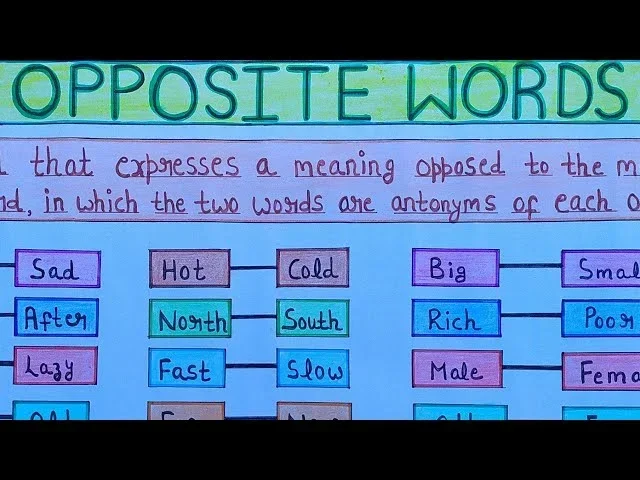
Antonym meaning refers to the definition of words that have opposite meanings. Understanding opposite words is a key part of building strong vocabulary and language skills. This guide covers the types of antonyms, real examples, and easy tips to help you learn faster. Whether you are a student or a writer, mastering antonym meaning will sharpen your word power and reading comprehension.
Have you ever wondered what antonym meaning really means? It is simpler than you might think. Antonym meaning is the definition of a word that has the opposite meaning of another word. For example, the antonym meaning of “hot” is “cold.” These opposite words are called antonyms, and they are a big part of how we use language every day.
When you understand antonym meaning, you get better at reading comprehension, writing skills, and everyday conversation. You start to see word pairs everywhere. This guide will walk you through everything you need to know. We will cover the types, give you clear examples, and share practical tips you can use right away.
Learning about antonym meaning is not just for school. It helps you in jobs, tests, and even casual chats. Strong vocabulary makes you a better communicator. And knowing opposite words is one of the fastest ways to grow that vocabulary. Let us get started.
Key Takeaways
- Antonym meaning is the definition of words that carry opposite meanings, and it is essential for strong communication.
- There are three main types of antonyms: gradable, complementary, and relational.
- Learning opposite word pairs boosts your vocabulary and makes reading comprehension easier.
- Using context clues is one of the fastest ways to discover the antonym meaning of unfamiliar words.
- Practicing with real examples and word pairs helps you remember antonyms longer.
- Antonym meaning plays a big role in writing skills, everyday conversation, and language learning.
- Avoiding common mistakes like confusing synonyms with antonyms keeps your word choices accurate.
📑 Table of Contents
What Does Antonym Meaning Really Mean?
The antonym meaning of a word is simply its opposite. In English grammar, an antonym is a word that means the reverse of another word. Think of it like a mirror. When you look at one word, its antonym meaning shows you the other side.
For instance, the word “happy” has a clear antonym meaning. The opposite is “sad.” That is the basic idea behind antonym meaning. But there is more to it than just one-word opposites. Antonyms come in different forms, and each type works in its own way.
Understanding antonym meaning also helps you see how semantic relationships work. Words do not exist in isolation. They connect to each other. Some words are synonyms, which means they have similar meanings. Others are antonyms, which means they have opposite word meanings. Both types are important for building strong language skills.
When you study antonym meaning, you also train your brain to think in categories. You start to group words by their opposites. This mental exercise strengthens your word power and makes you faster at finding the right word choices when you speak or write.
Why Learning Antonyms Helps You Speak Better
Knowing antonym meaning gives you a real advantage in communication. It is not just about memorizing lists. It is about understanding how language works. When you know the opposite of a word, you understand that word better too.
It Boosts Your Vocabulary Fast
One of the best ways to grow your vocabulary is to learn word pairs. When you learn that “big” means the opposite of “small,” you actually learn two words at once. This vocabulary building trick saves you time and effort. Instead of memorizing words alone, you link them to their antonym meaning. This makes them stick in your memory longer.
It Improves Reading Comprehension
When you read a book or an article, you often meet words you do not know. In those moments, context clues become your best friend. If a sentence says “The room was not bright; it was quite dark,” you can figure out the meaning of “dark” because you know its antonym meaning is “bright.” This skill is called using context clues, and it is a powerful reading comprehension tool.
It Makes Your Writing Stronger
Good writers use opposite words to create contrast. Contrast makes writing more interesting. When you know the antonym meaning of words, you can write sentences that pop. You can show differences, create tension, and make your ideas clearer. Your writing skills will improve fast when you start using antonyms on purpose.
It Helps in Everyday Conversation
Even in casual talks, antonym meaning matters. When someone says “This food is not bland; it is very spicy,” they are using opposites to make their point clear. Knowing antonyms helps you follow these conversations and respond with confidence. It also helps you express your own ideas more precisely.
The Three Main Types of Antonyms Explained
Not all antonyms work the same way. Linguists, which are experts in language, divide antonyms into three main types. Each type has its own rules. Let us look at each one closely.
Gradable Antonyms
Gradable antonyms are opposite words that exist on a scale. Think of temperature. “Hot” and “cold” are gradable antonyms because there are many levels in between. Warm, cool, lukewarm, and freezing all sit on that same scale. The antonym meaning of “hot” is “cold,” but there are many shades in between.
Other examples of gradable antonyms include:
- Tall and short
- Fast and slow
- Bright and dim
- Young and old
- Loud and quiet
With gradable antonyms, you can use words like “very” or “extremely” to show degree. You can say “very tall” or “extremely quiet.” This is a key feature of the antonym meaning in gradable pairs.
Complementary Antonyms
Complementary antonyms are opposite words with no middle ground. Something is either one or the other. There is no scale. The antonym meaning of “alive” is “dead.” Something cannot be a little bit alive or a little bit dead. It is one or the other.
Here are more examples of complementary antonyms:
- Alive and dead
- True and false
- Yes and no
- Pass and fail
- Open and closed
Understanding antonym meaning in complementary pairs is important because it teaches you that some opposites are absolute. There is no room for “almost” or “somewhat.” This clear-cut antonym meaning is very useful in logic, tests, and precise word choices.
Relational Antonyms
Relational antonyms are opposite words that only make sense in relation to each other. One word cannot exist without the other in the pair. The antonym meaning of “teacher” is “student.” You cannot have a teacher without a student, and vice versa. These opposite words depend on each other.
Here are more examples of relational antonyms:
- Teacher and student
- Buy and sell
- Parent and child
- Borrow and lend
- Employer and employee
The antonym meaning in relational pairs is different from gradable or complementary types. It is about the relationship between two roles or actions. When you understand this type, you see how semantic relationships connect people, actions, and ideas in everyday conversation.
Common Antonym Pairs You Should Know
Some antonyms are so common that you probably use them every day without thinking. But knowing their antonym meaning by name helps you use them with more confidence. Here is a list of popular opposite word pairs that every English learner should know.
Basic Antonym Pairs:
- Up and down
- In and out
- On and off
- Left and right
- High and low
Descriptive Antonym Pairs:
- Beautiful and ugly
- Kind and cruel
- Brave and fearful
- Clean and dirty
- Rich and poor
Time-Related Antonym Pairs:
- Morning and night
- Early and late
- Past and future
- Fast and slow (time-related)
- New and old
Notice how some antonyms appear in more than one category. The word pair “fast and slow” can be both gradable and relational depending on how you use it. This shows that antonym meaning is flexible and depends on context. The same two words can have slightly different antonym meaning in different situations.
How to Find the Antonym Meaning of Any Word
Sometimes you meet a word you do not know, and you need to find its antonym meaning quickly. Here are the best methods to do that.
Use Context Clues
Context clues are hints in the sentences around a word. If a sentence says “The generous donor gave away all his money,” you can guess that “generous” has the antonym meaning of “stingy” or “selfish” because the sentence shows the opposite behavior. This is one of the most practical language skills you can develop.
Use a Dictionary
A good dictionary will often list antonyms right under the word definitions. When you look up a word, check the section that says “Antonyms.” This is a direct way to learn the antonym meaning of any word. Many online dictionaries also show synonyms and related words side by side.
Use Word Roots and Prefixes
Some word roots and prefixes can help you figure out antonym meaning. For example, the prefix “un-” often creates an opposite. Happy becomes unhappy. Do becomes undo. Lucky becomes unlucky. Learning common word roots and prefixes is a shortcut to finding antonyms without a dictionary.
Use Flashcards and Apps
Digital tools make learning antonyms fun and easy. Flashcard apps let you practice word pairs every day. You can set daily goals and track your progress. This kind of regular practice builds strong language learning habits. Over time, you will know the antonym meaning of hundreds of words without even trying.
Tips to Build Your Antonym Vocabulary
Building a strong antonym vocabulary takes practice, but it does not have to be boring. Here are some tips that actually work.
- Learn word pairs together. Never learn a word alone. Always learn its antonym meaning at the same time. This links the words in your memory.
- Use new words in sentences. Write a sentence with the word and its antonym. This helps you understand the antonym meaning in action.
- Read widely. Books, articles, and blogs expose you to opposite words in different contexts. This builds your reading comprehension and vocabulary at the same time.
- Play word games. Crossword puzzles, word searches, and vocabulary quizzes make learning antonyms fun. They also test your word power in a low-pressure way.
- Keep a vocabulary journal. Write down new word pairs every day. Review them weekly. This simple habit builds strong language skills over time.
- Practice with a friend. Quiz each other on antonyms. Making it social keeps you motivated and makes the learning stick.
Common Mistakes People Make with Antonyms
Even native speakers sometimes make mistakes with antonyms. Here are the most common ones and how to avoid them.
Confusing Synonyms with Antonyms
The biggest mistake is mixing up synonyms and antonyms. A synonym has a similar meaning, while an antonym has an opposite antonym meaning. Always double-check whether you need a word that is similar or opposite. This small step can save you from embarrassing word choices.
Assuming All Opposites Are Antonyms
Not every opposite word is a true antonym. Some words just happen to be different but do not form a direct antonym meaning pair. For example, “cat” and “dog” are different animals, but they are not antonyms. True antonyms must share the same category and have opposite word meanings within that category.
Ignoring Gradability
Another mistake is treating all antonyms the same way. As we learned earlier, gradable antonyms have middle ground, but complementary antonyms do not. Using “very” with a complementary antonym does not make sense. You cannot say “very alive” in the same way you say “very tall.” Understanding this difference sharpens your language skills and word choices.
Conclusion
Learning about antonym meaning is one of the best things you can do for your language skills. It boosts your vocabulary, improves your reading comprehension, and makes your writing skills stronger. You now know the three types of antonyms, how to find antonym meaning for any word, and practical tips to build your opposite word knowledge every day.
The beauty of antonym meaning is that it is simple but powerful. You do not need to memorize long lists. Just learn word pairs together, use context clues when you read, and practice a little every day. Your word power will grow faster than you think.
Start today. Pick five new antonyms and write sentences with them. Share what you learn with a friend. The more you practice, the more natural antonym meaning will become. Strong vocabulary is within your reach, and it all starts with understanding opposite words.
Frequently Asked Questions
What is the antonym meaning of the word “beautiful”?
The antonym meaning of “beautiful” is “ugly.” These two words form a gradable antonym pair because there are many levels in between, such as “attractive,” “plain,” and “unattractive.” Understanding antonym meaning in descriptive words like this helps you choose the right word choices in everyday conversation and writing skills.
Why is antonym meaning important for language learning?
Antonym meaning is important because it helps you understand words faster and remember them longer. When you learn that “bright” has the antonym meaning of “dim,” you actually learn two word definitions at once. This vocabulary building strategy saves time and strengthens your reading comprehension and language skills at the same time.
What are the three types of antonyms?
The three types of antonyms are gradable, complementary, and relational. Gradable antonyms exist on a scale, like “hot” and “cold.” Complementary antonyms have no middle ground, like “alive” and “dead.” Relational antonyms depend on each other, like “teacher” and “student.” Knowing these types helps you understand antonym meaning more deeply.
How can I quickly find the antonym meaning of a new word?
The fastest way is to use context clues in the sentences around the word. You can also check a dictionary, which usually lists antonyms under each word definition. Another helpful trick is to look for common prefixes like “un-” or “in-” that create opposite words. These methods make learning antonym meaning quick and easy.
Can a word have more than one antonym meaning?
Yes, absolutely. Many words have multiple antonyms depending on the context. The word “light” can have the antonym meaning of “dark” (when talking about brightness) or “heavy” (when talking about weight). This shows that antonym meaning is flexible and always depends on how the word is used. Paying attention to context is key to getting the right opposite word.
Is there a difference between antonyms and opposites?
In everyday use, people often use “antonyms” and “opposites” to mean the same thing. However, in English grammar, antonyms are a specific type of semantic relationship where two words share the same category but have opposite word meanings. Not every opposite is a true antonym. True antonyms must be in the same category, like “hot” and “cold” in the temperature category. Understanding this difference improves your language skills and word choices.